Of every pathway I discuss with clients, Family Class is the one where people are most likely to assume the process is simpler than it actually is — “we’re married, so I sponsor her” or “he’s my father, so I sponsor him.” The relationship itself is rarely the hard part. Proving it, documenting it correctly, and understanding which specific sub-category actually applies is where genuinely qualifying families run into real, avoidable delay.
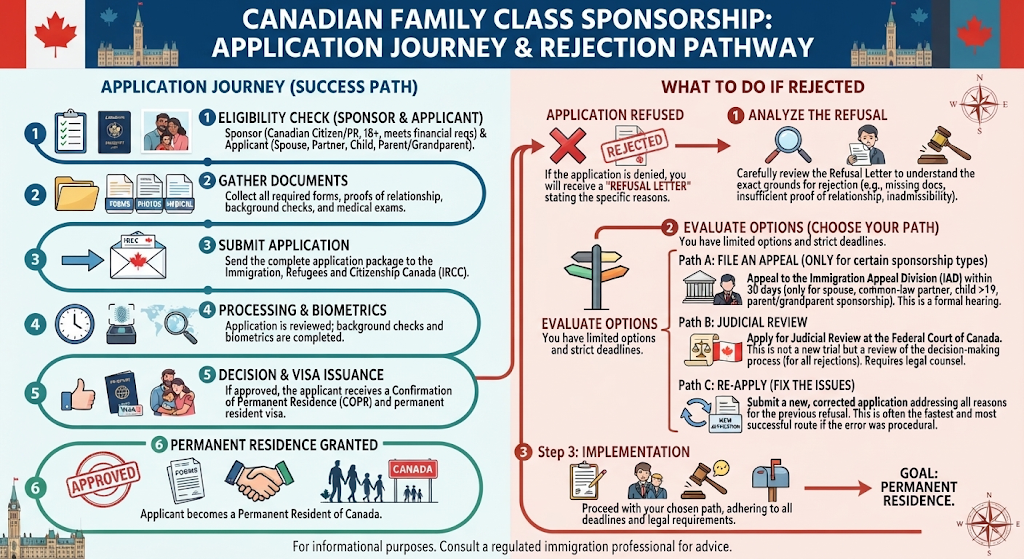
1. What Is Family Class Sponsorship?
Family Class, governed by IRPR section 117, allows a Canadian citizen or permanent resident to sponsor specific relatives for permanent residence. It isn’t one program — it’s a group of distinct sub-categories, each with its own eligibility test, documentation standard, and processing timeline:
Spouses, common-law partners, and conjugal partners (section 117(1)(a)) — the most common Family Class application, and currently the fastest, typically processed around 12 months. Dependent children (section 117(1)(b)) — biological or adopted children under 22 who are unmarried and not in a common-law relationship, with a narrow exception for dependents 22 or older who rely on a parent due to a physical or mental condition. Parents and grandparents, through the Parents and Grandparents Program (PGP)(Currently paused) — currently the most restricted category, discussed below. A narrower category covering an orphaned sibling, niece, nephew, or grandchild under 18, where no other relative is available to sponsor them, in genuinely limited circumstances.
2. What Is the Qualification for Family Class Sponsorship?
Eligibility runs on two separate tracks: the sponsor’s own eligibility to sponsor, and the sponsored relative’s eligibility to be sponsored.
Sponsor eligibility generally requires being a Canadian citizen or permanent resident at least 18 years old, residing in Canada (or, for a citizen sponsoring a spouse, intending to reside in Canada once the sponsored person becomes a permanent resident), and meeting specific financial conditions — not being in default of a previous sponsorship undertaking, not currently receiving social assistance for a reason other than disability, and not undischarged bankrupt. Notably, and unlike parent/grandparent sponsorship, spousal and partner sponsorship carries no minimum income requirement — a sponsor can be unemployed or a student and still qualify, since the exemption reflects a deliberate policy choice prioritizing family reunification over financial gatekeeping for spouses specifically.
Spousal/partner eligibility turns on the genuineness of the relationship — a legally valid marriage, or 12 months of continuous cohabitation for common-law status, or, for a conjugal partner, an established relationship where cohabitation genuinely wasn’t possible.
Dependent child eligibility requires the child to be under 22 and unmarried at the time the application is submitted — this threshold isn’t flexible the way it once was; a 2017 regulatory change removed the previous exception that allowed full-time students over 22 to still qualify.
Parent and Grandparent Program (PGP) eligibility, when the program is accepting applications, requires the sponsor to meet the Minimum Necessary Income (the Low Income Cut-Off plus 30%) for three consecutive tax years, calculated against a household size that includes the sponsor, their spouse, their dependent children, and the relatives being sponsored. As of 2026, this matters more than usual: IRCC is not currently accepting new PGP applications or Interest-to-Sponsor forms — intake has been paused since January 2026, with no announced reopening date. Applications from the 2025 invitation round continue processing, but no new families can enter the queue right now.
For families who want their parents or grandparents in Canada while PGP intake remains closed, the practical fallback is the Super Visa — a multiple-entry temporary resident visa valid for up to 10 years total, allowing stays of up to 5 years at a time (longer than a standard visitor visa’s 6-month limit). As of March 31, 2026, the income test for a Super Visa host became more flexible: hosts can now use either of their two most recent tax years to qualify, and a visiting parent’s own recurring income (such as a foreign pension) can help close a shortfall once the host clears a minimum threshold.
Official IRCC page: https://www.canada.ca/en/immigration-refugees-citizenship/services/immigrate-canada/family-sponsorship.html
3. Who Is Actually Prepared for Family Class Sponsorship?
A genuinely well-positioned sponsor and applicant typically have:
For spousal/partner cases: consistent, dated evidence of the relationship spanning a real period of time — joint finances, communication records, travel together, involvement with each other’s families — not just a marriage certificate standing alone. For dependent child cases: clear documentation the child is genuinely under 22 and unmarried, with no ambiguity in birth or adoption records. For PGP cases (once reopened): three consecutive tax years already meeting the Minimum Necessary Income threshold, with clean Notices of Assessment ready to submit. For all categories: a sponsor who meets the eligibility conditions cleanly — no default on a prior undertaking, no unresolved inadmissibility issues for either party.
4. What Is the Most Common Reason Family Class Applications Fail?
The single most common issue, by a wide margin, is an officer not being satisfied the relationship is genuine or wasn’t entered into primarily for immigration purposes — the same genuineness test discussed in our spousal sponsorship pitfalls guide. Beyond that, common failure points include: undeclared family members from a sponsor’s own prior PR application (a permanent, unappealable bar under section 117(9)(d)); incomplete financial disclosure specifically for PGP applications; and, for dependent children, ambiguity or inconsistency around age, marital status, or the child’s actual dependency.
5. What’s the Most Important Thing to Pay Attention to When Preparing a Family Class Application?
Match your specific relationship to its specific sub-category before you build anything else. Spousal, dependent child, and PGP applications aren’t interchangeable variations of one process — each has its own evidentiary standard, its own financial test (or, for spouses, deliberately none), and, right now, dramatically different actual availability. Building a PGP-style financial disclosure package for a spousal application, or vice versa, wastes real time on the wrong documentation entirely.
6. If My Situation Doesn’t Currently Qualify, What Can I Do?
For PGP specifically, since intake is currently closed with no announced reopening: apply for a Super Visa in the meantime, keep tax filings, passports, and civil documents current so you can act immediately once intake reopens, and monitor IRCC’s official announcements directly rather than relying on rumored reopening dates.
For a spousal or partner case with weak relationship evidence: build a genuinely stronger evidentiary record over time — joint accounts, shared leases, travel history — rather than submitting prematurely with a thin file that invites exactly the genuineness scrutiny discussed above.
For a dependent child case near the age 22 threshold: timing matters enormously here — the child’s age and marital status at the time of application submission is what’s assessed, so submitting before a birthday or a marriage can be the difference between eligibility and ineligibility entirely.
7. When the Sponsored Person Has a Criminal Record
A criminal record belonging to the sponsored person is a separate, and often more serious, rejection ground entirely — and one that doesn’t get resolved by better relationship evidence, no matter how genuine the relationship actually is. If a conviction outside Canada would be treated as a crime under Canadian law, the sponsored person is generally criminally inadmissible unless that inadmissibility has been formally overcome.
There are two routes to overcoming it: deemed rehabilitation, which applies automatically once enough time has passed (generally 10 years since a single indictable-equivalent sentence was completed, or 5 years for two or more summary-equivalent convictions, provided the offence’s Canadian equivalent carries a maximum sentence under 10 years); and individual rehabilitation, a formal application to IRCC required for anything more serious or where the deemed-rehabilitation timeline hasn’t yet been met. Critically, deemed rehabilitation isn’t automatically obvious to a visa officer — even where it technically applies, the sponsored person still needs to document it clearly (court records, proof the sentence was fully completed) for the officer to actually recognize it at the time of application.
Where neither route currently applies, the family class application will generally be refused for inadmissibility, not for any deficiency in the relationship itself — and, importantly, this specific inadmissibility ground also affects appeal rights under section 64(1), discussed below. We cover the deemed vs. individual rehabilitation process, eligibility timelines, and required documentation in full in our dedicated guide on criminal records and Canadian immigration.
8. If My Family Class Application Is Refused, What Can Be Done?
The right next step depends entirely on which sub-category was refused and how — this isn’t the same analysis as an economic-class refusal, because Family Class has its own appeal structure built specifically around sponsorship.
The general rule: under IRPA section 63(1), a sponsor whose family class application was refused can appeal to the Immigration Appeal Division (IAD) — but only where the refusal was a refusal to issue a permanent resident visa. This single word is why the analysis splits sharply by category:
Parents and grandparents, dependent children applying from abroad, and other-relative sponsorships are always processed as visa applications from outside Canada, so a refusal here generally does carry IAD appeal rights, filed within 30 days of the refusal.
Outland spousal, common-law, and conjugal partner sponsorships work the same way — a genuine visa refusal, so IAD appeal rights are generally available.
Inland spousal or common-law sponsorships (the “Spouse or Common-Law Partner in Canada” class) are different: the sponsored spouse is already in Canada and is requesting a status change, not a visa. Following the IRB’s 2012 decision in Palma Izaguirre v. Canada, the IAD has held it simply has no jurisdiction over these refusals — there’s no appeal route at all. Your only options are a stronger reapplication or, where there’s a genuine legal error, judicial review at the Federal Court.
Two further limits apply across every category: under IRPA section 64(1), no appeal is available where the sponsor or sponsored person is inadmissible for serious criminality, security, organized criminality, or human or international rights violations — [[ADDED]] this is the same criminal inadmissibility ground discussed above, and it’s worth being precise about the threshold: section 64(2) defines “serious criminality” here specifically as an offence punishable in Canada by a maximum sentence of at least 10 years, or an actual sentence of more than 6 months — a lower-level, non-rehabilitated conviction may still be a valid reason for refusal, but it doesn’t necessarily strip away appeal rights the way a genuinely serious offence does. And under section 64(3), a misrepresentation-based refusal keeps its appeal right only where the sponsored person is a spouse, common-law partner, or child — a misrepresentation refusal in a parent, grandparent, or other-relative case loses IAD appeal rights entirely, even though the same refusal for a spousal case wouldn’t.
Choosing between an appeal and a fresh application, practically: an IAD appeal is usually the better route where you already have strong, genuine evidence the officer didn’t properly weigh, where there’s a real argument of unfairness or legal error, or where humanitarian and compassionate factors — including a child’s best interests — could support relief the IAD can grant but a reapplication can’t raise at all. A fresh application tends to make more sense where the refusal came down to something genuinely fixable: thin documentation, a disclosure gap, or evidence that simply didn’t exist yet at the time of the original application. Where no appeal right exists at all — inland refusals, or refusals barred under section 64 — reapplication or judicial review are the only paths forward, and choosing between those two follows the same logic covered in our judicial review and immigration appeal guide.
9. If Family Class Sponsorship Isn’t a Fit, What Pathway Might Fit Better?
If your relative doesn’t qualify under any Family Class sub-category: Humanitarian and Compassionate consideration under IRPA section 25(1) may apply in genuinely exceptional circumstances, though it’s discretionary and not a routine fallback.
If you’re the one seeking to immigrate and don’t have a qualifying Canadian relationship: Express Entry (FSWP, CEC, or FSTP) or a Provincial Nominee Program may be the more realistic route, assessed entirely on your own profile rather than a family connection.
If you’re specifically trying to bring parents or grandparents to Canada right now: the Super Visa, while not permanent residence, is currently the only practically available route while PGP intake remains paused.
If You’re Not Sure Which Category Applies
Because Family Class isn’t one program but several distinct sub-categories — each with a different evidentiary bar, a different financial test, and, as of 2026, dramatically different actual availability — matching your specific relationship to the right one, and building the right evidence for it from the start, is where families most often lose time they didn’t need to. Serving Vancouver and clients across all of BC, Katrina Berube Law assesses your specific relationship against the correct sub-category’s real requirements before any application is built, so your file is positioned to succeed the first time it’s reviewed.