Over 19 years of practice, I’ve found that most people researching Express Entry are actually asking one of two very different questions without realizing it: “am I eligible for this program” and “will I actually get invited.” These are separate scoring systems entirely, and confusing them is the single most common reason people either give up too early or apply with false confidence. This guide walks through both, in full.
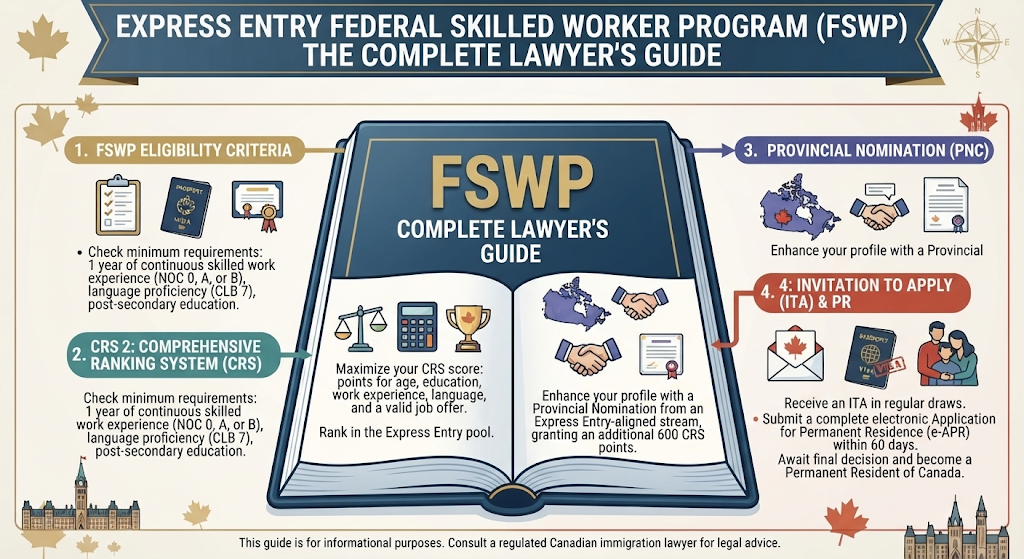
1.What Is Express Entry, and What Is the Federal Skilled Worker Program?
Express Entry is the online system IRCC uses to manage applications for three federal economic immigration programs: the Federal Skilled Worker Program (FSWP), the Federal Skilled Trades Program (FSTP), and the Canadian Experience Class (CEC). You don’t apply to “Express Entry” itself — you qualify for one of these three underlying programs, then submit a profile into the shared Express Entry pool.
The Federal Skilled Worker Program specifically is built for skilled workers with foreign work experience, no Canadian job offer required, and no prior Canadian work experience required. This is what makes it distinct from the CEC (which requires Canadian work experience) and the FSTP (which is trade-specific). If you’re living outside Canada with no Canadian ties at all, FSWP is very often the only one of the three programs you’re actually eligible for.
Once your profile is accepted into the pool, it’s ranked using the Comprehensive Ranking System (CRS), scored out of 1,200 points. IRCC periodically runs draws — general draws, category-based draws (targeting specific occupations or French ability), and Provincial Nominee draws — inviting the top-ranked candidates in each round to apply for permanent residence.
Express Entry — Program Overview in the Official IRCC Page: https://www.canada.ca/en/immigration-refugees-citizenship/services/immigrate-canada/express-entry.html
2. What Is the Qualification for Express Entry as a Skilled Worker?
Qualifying for FSWP happens in two separate stages, and this is where the confusion I mentioned above usually starts.
Stage One: Minimum Eligibility Requirements
Before any points are calculated, you must meet every one of these minimums. Remember, these are the minimum:
- Skilled work experience: At least one year of continuous full-time (or the equivalent in part-time) work in the last 10 years, in an occupation classified under NOC TEER 0, 1, 2, or 3 — roughly 370 eligible occupations.
- Language ability: A minimum of Canadian Language Benchmark (CLB) 7 in all four abilities — reading, writing, listening, speaking — in English or French, from an approved test (IELTS or CELPIP for English; TEF or TCF for French). Scoring below CLB 7 in even one ability makes you ineligible, regardless of every other factor.
- Education: If educated outside Canada, an Educational Credential Assessment (ECA) from an approved organization, confirming your credential’s Canadian equivalency.
- Proof of funds: Sufficient settlement funds to support yourself and any accompanying family members, unless you already have valid Canadian work authorization or a qualifying job offer.
Stage Two: The 67-Point Selection Grid
Only once you meet every minimum above does IRCC assess you against the FSWP’s own 67-point selection grid — a separate scoring system from the CRS, used only to determine basic eligibility for the program itself:
- Language skills — maximum 28 points (24 for your first official language, 4 for a second)
- Education — maximum 25 points
- Skilled work experience — maximum 15 points
- Age — maximum 12 points
- Arranged employment in Canada — maximum 10 points
- Adaptability — maximum 10 points (factors like a spouse’s education/language ability, prior Canadian work or study experience, or a relative living in Canada)
You need at least 67 of these 100 points to qualify for the program. Scoring below 67 means you cannot submit an Express Entry profile under FSWP at all — this grid is pass/fail, not a ranking tool.
Only after clearing 67 points do you enter the Express Entry pool, where an entirely separate score — your CRS, out of 1,200 — determines whether and when you actually receive an invitation. You may refer full point tables from the official IRCC page.
One important note: the Federal Skilled Worker Program doesn’t apply if you intend to settle in Quebec — Quebec selects its own skilled workers through a separate provincial system.
3. Who Is Actually Prepared for the Express Entry FSWP Pathway?
Based on the eligibility structure itself, a genuinely well-prepared candidate typically has most of the following:
At least one year of continuous work experience that clearly and provably falls under a TEER 0–3 occupation — not just related work, but work whose actual duties match the NOC’s official description. CLB 9 or higher across all four language abilities, since this is where the largest single score gains are usually available, in both the 67-point grid and the CRS. A completed ECA (Educational Credential Assessment) already in hand, or well underway, since it can take several months and its results affect nearly every downstream calculation. An age profile under roughly 35–40(younger gives higher score), since age points (in both scoring systems) begin declining from the early 30s onward. Enough liquid, provable settlement funds already organized — not just available, but ready to document with clean bank statements. No unresolved criminal or medical inadmissibility issues, and no misrepresentation risk in prior visa history.
None of these are strict requirements to apply — but candidates missing several of them at once tend to either fail the 67-point threshold outright, or clear it and then sit in the pool indefinitely without a competitive CRS score.
Federal Skilled Worker Program — Eligibility from the Official IRCC Page: https://www.canada.ca/en/immigration-refugees-citizenship/services/immigrate-canada/express-entry/eligibility/federal-skilled-workers.html
4. What Is the Most Common Reason People Fail in the FSWP Pathway?
In my experience, and consistent with what IRCC’s own program evaluations show, failure clusters around a small number of repeat issues:
Occupation mismatch: The applicant’s actual job duties don’t match the specific NOC code they’ve claimed, discovered either at the 67-point stage or, worse, after an Invitation to Apply, when it’s far more costly to fix. Missing CLB 7 in a single ability: Often reading or writing, while listening and speaking scores are strong — this alone makes someone ineligible regardless of every other point they’d otherwise have. Incomplete or delayed ECA: Applicants underestimate how long this takes, then rush the rest of their file trying to catch up. Assuming 67 points is the finish line: Clearing the FSWP grid only gets you into the pool — a low CRS score can mean an indefinite wait with no invitation, which many applicants don’t realize until they’re already in the pool. Proof of funds that doesn’t hold up to documentation standards: Funds that exist but aren’t in an account, form, or currency that meets IRCC’s specific documentation requirements.
5. What Is the Most Important Thing to Pay Attention to in Preparing for FSWP?
If I had to isolate one thing: get your NOC code right before you build anything else around it.
Your entire application — eligibility, the 67-point grid, and later verification at the permanent residence stage — is built on the specific NOC code you claim. If your actual job duties don’t genuinely match that code’s official description, everything downstream is built on an unstable foundation, and this is discoverable at multiple points in the process, sometimes well after you’ve already invested significant time and money.
The second most important thing, close behind: don’t finalize your language test strategy until you understand both scoring systems. A CLB improvement can simultaneously raise your 67-point grid score and your CRS score, which is precisely why language investment tends to have the best overall return of any single action a candidate can take.
Federal Skilled Worker Program — Six Selection Factors (Full Point Grid) from the Official IRCC page: https://www.canada.ca/en/immigration-refugees-citizenship/services/immigrate-canada/express-entry/become-candidate/eligibility/federal-skilled-workers/six-selection-factors-federal-skilled-workers.html
6. If I Lack Points, What Can I Do to Raise Them?
This applies to both the 67-point grid and, separately, your CRS ranking once you’re in the pool:
Retake your language test. This is usually the highest-leverage move available, since language touches the 67-point grid, your core CRS points, and several CRS skill transferability bonuses simultaneously. Complete another credential. A higher education level raises both your 67-point education score and your CRS education score, and a Canadian credential specifically adds separate CRS Additional Points. Secure a genuine offer of arranged employment. Worth up to 10 points on the 67-point grid — though as of March 2025, a job offer no longer adds CRS points separately, so its main value now is on this grid and toward program eligibility itself. Gain more qualifying work experience. Raises the experience factor on both scoring systems. Take a French language test. Even as a secondary language, strong French ability adds meaningful CRS points and improves standing in French-language category draws. Pursue a provincial nomination. This doesn’t affect the 67-point grid, but it adds 600 CRS points — effectively guaranteeing an invitation once you’re in the pool.
7.If I’m Not a Fit for FSWP, What Pathway Might Fit Better?
FSWP isn’t the right door for everyone, and it’s rarely the only one available:
If you have Canadian work experience already: The Canadian Experience Class is often faster and doesn’t carry the same rigid 67-point threshold. If you work in a skilled trade: The Federal Skilled Trades Program has a lower language bar (CLB 5 speaking/listening, CLB 4 reading/writing) and no formal education requirement, provided you have a certificate of qualification or a valid trade job offer. If a specific province needs your occupation: A Provincial Nominee Program may accept you even where your general CRS score wouldn’t otherwise be competitive. If you have a spouse, partner, or close family member in Canada: Family sponsorship runs on an entirely different test — relationship genuineness, not points — and may be available regardless of your CRS score. If you’re early in your career or lack Canadian credentials: A study permit, followed by a Post-Graduation Work Permit, can be a deliberate, longer-term path toward building exactly the Canadian education and experience that later makes CEC or a stronger FSWP profile realistic.
The honest starting point for any of these is the same: an accurate assessment of where your actual profile sits today, against each program’s real requirements — not the one you assume fits best.
8. If You’re Not Sure Which Pathway Fits
This is precisely the kind of assessment worth having reviewed properly before you invest months into language testing, credential assessments, or a program you may not actually be eligible for. Serving Vancouver and clients across all of BC, Katrina Berube Law assesses your full profile against every available pathway — not just the one you walked in asking about — before building your application.