A work permit application rarely fails because the applicant wasn’t qualified for the job. It fails because the file didn’t clearly prove the specific legal test the officer is actually required to apply — and that test changes depending on which of Canada’s two entirely different work permit systems you’re applying under. Understanding which system you’re in, and what it actually requires, is where a genuinely strong application starts.
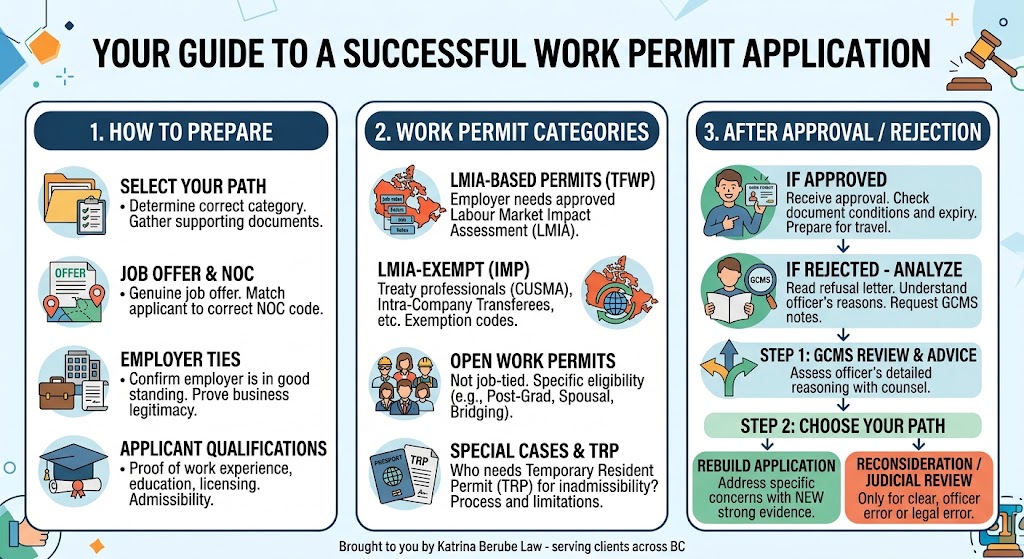
1. Who Needs a Work Permit?
Almost anyone intending to work in Canada needs a work permit — but “work” has a specific legal meaning, and a narrow list of activities under IRPR section 186 is exempt entirely: certain business visitors attending meetings without entering the Canadian labour market, some performers, certain clergy, and a handful of other specific categories. If your activity doesn’t fall into one of these narrow exemptions, you need a work permit before you start — not after.
2. Types of Work Permit
There are two structurally different systems, and knowing which one applies changes your entire strategy:
LMIA-based (Temporary Foreign Worker Program): Your employer must first obtain a positive Labour Market Impact Assessment from Employment and Social Development Canada (ESDC), confirming the hire won’t displace a Canadian worker. This requires the employer to advertise the position, demonstrate a genuine labour shortage, and pay a non-refundable $1,000 fee per position — non-refundable even if the LMIA is refused.
LMIA-exempt (International Mobility Program): A broad set of categories where a treaty, reciprocal arrangement, or significant benefit to Canada justifies skipping the labour market test entirely. This covers intra-company transferees, professionals under trade agreements (CUSMA, CETA, CPTPP, CUKTCA), Mobilité Francophone, reciprocal employment, and more — roughly eleven distinct exemption categories, each with its own specific requirements. The employer still submits an Offer of Employment through the IRCC Employer Portal and pays a $230 compliance fee, but skips the advertising period and the ESDC labour market review entirely.
Open work permits sit apart from both: they’re not tied to a single employer or job. This includes the Post-Graduation Work Permit, Bridging Open Work Permits (for applicants awaiting a PR decision on an existing, valid work permit), International Experience Canada permits, and spousal/partner open work permits — though it’s worth knowing the spousal open work permit rules tightened significantly in 2024 and 2025, and it’s no longer as broadly available as it once was, so eligibility needs to be confirmed against the current rules rather than assumed.
Choosing the wrong pathway — defaulting to an LMIA application when an IMP exemption actually applies, or picking the wrong exemption code within the IMP — is one of the most common, and most expensive, mistakes we see. We identify the correct category before any application is filed, not after months have already been spent on the wrong one.
3. How to Prepare Work Permit Documents
A strong file generally includes:
- A genuine, detailed offer of employment, specifying duties, wages, and conditions that match the position’s actual NOC classification
- Proof of your qualifications to perform the specific job — education, licensing, and relevant experience
- For LMIA-based permits, the employer’s positive LMIA and confirmation number
- For IMP permits, the correct exemption code and supporting evidence for that specific category (trade agreement eligibility, intra-company transfer documentation, reciprocity evidence, etc.)
- Evidence supporting your intention to comply with the conditions of your stay Proof of admissibility — no unresolved criminal or medical inadmissibility
The documents that matter most differ significantly depending on which of the two systems above you’re in — this is precisely why we build the document list around your specific category, not a generic template.
4. Most Common Cause of Work Permit Rejection
For LMIA-based applications, refusals often stem from issues in the LMIA itself: insufficient advertising by the employer, inability to demonstrate a genuine labour shortage, wages or conditions below the required provincial standard, or employer compliance issues from prior hiring. A negative LMIA cannot itself be appealed — the employer has to address the deficiency and submit a fresh application.
For IMP applications, the most common cause is choosing the wrong exemption category entirely, or failing to document that category’s specific requirements clearly enough for an officer to confirm eligibility on the file alone.
Across both systems, general causes include a job offer that doesn’t clearly match the applicant’s stated qualifications, incomplete or inconsistent documentation, and — as with any temporary resident application — insufficient evidence that you’ll comply with the conditions of your permit.
5. What Can Be Done If a Work Permit Is Rejected?
The right next step depends on why the refusal happened. Where the LMIA itself was refused, the employer needs to directly address the specific deficiency ESDC identified — a fresh application without changing the underlying issue rarely succeeds. Where an IMP application was refused, confirming the correct exemption category was actually used, and rebuilding the file around that category’s real requirements, is usually the more direct fix than reapplying under the same terms.
In both cases, requesting the officer’s case notes through a Privacy Act request often reveals the specific concern behind a refusal letter that otherwise cites only a general ground — the same practical first step that applies to a visitor visa refusal.
6. Who Should Consider Judicial Review for a Work Permit Rejection?
As with a visitor visa, there is no Immigration Appeal Division route for a work permit refusal — “appealing” a work permit decision means one of: a rebuilt reapplication, a reconsideration request for a clear, identifiable error, or judicial review at the Federal Court, filed within 15 days if you’re in Canada or 60 days if outside Canada.
Judicial review is worth pursuing where there’s a genuine, documented legal error or fairness breach — not simply disagreement with the outcome. Given the Vavilov reasonableness standard discussed in our judicial review guide, a case built on a real, identifiable flaw in the officer’s reasoning is a fundamentally different, and stronger, position than one built on frustration with a discretionary call. We assess your refusal against that specific distinction before recommending this route.
7. I Have a Criminal Record and Wasn’t Rehabilitated — Can I Still Apply for a Work Permit?
Not on its own — a conviction that would be treated as a crime under Canadian law generally makes you criminally inadmissible, and a work permit application will typically be refused on that basis unless the inadmissibility has been addressed first. But “not yet rehabilitated” doesn’t necessarily mean “no path forward right now.”
As covered in our full guide to criminal records and Canadian immigration, a Temporary Resident Permit (TRP) can temporarily overcome inadmissibility for a specific, compelling reason, at an officer’s discretion. Critically, a TRP itself doesn’t authorize work — but if it’s issued for at least 6 months, you can apply for a work permit alongside it. This is often the practical bridge for someone who needs to work now but isn’t yet eligible for deemed or individual rehabilitation. It’s a temporary solution, not a permanent fix — pursuing rehabilitation in parallel is almost always the better long-term strategy, rather than relying on repeated TRP renewals indefinitely.
8. Understanding the Underlying Principle of Work Permit Supporting Documents
Every document in a work permit file is ultimately answering one of two questions, depending on your pathway: for LMIA-based applications, is this a genuine job that a Canadian worker couldn’t fill — protecting the integrity of the Canadian labour market; for IMP applications, does this specific situation genuinely fall within the treaty, policy, or reciprocal benefit that justifies skipping that labour market test. Layered underneath both, for every work permit application, is the same baseline question that governs every temporary resident application: will you comply with the conditions of your stay.
Once you see documents through this lens, preparation stops being a checklist exercise and becomes a matter of building genuine, specific proof toward the actual question your category is asking — which is the difference between a file that merely looks complete and one that’s actually persuasive.
9. Where Katrina Berube Law Makes the Difference
Work permit applications fail less often from missing paperwork than from paperwork built around the wrong question — the wrong exemption code, a job offer that doesn’t clearly answer what the specific pathway requires, or a criminal history addressed too late in the process. Serving Vancouver and clients across all of BC, Katrina Berube Law identifies the correct pathway and its actual underlying test before your application is built, so your file answers the question an officer is genuinely asking — not the one a generic template assumes.