Of every temporary resident application, the visitor visa looks the simplest on paper and causes the most heartbreak in practice — because “the broadest, most document-light status” doesn’t mean “the easiest to get right.” Most refusals I review didn’t fail on eligibility. They failed on presentation: the applicant genuinely met the standard, but never actually showed it clearly enough for an officer to see it too.
1. Who Needs a Visitor Visa?
Whether you need a visitor visa (officially a Temporary Resident Visa, or TRV) or an Electronic Travel Authorization (eTA) depends entirely on your citizenship, not your travel plans:
Visa-exempt countries — citizens of the UK, most EU member states, Australia, Japan, South Korea, and several others generally only need an eTA: a quick, electronic authorization linked to your passport, valid for up to five years.
Visa-required countries — citizens of countries including China, India, Nigeria, the Philippines, and many others need a full TRV: a physical or digital visa placed in your passport, requiring a formal application. U.S. citizens need neither a TRV nor an eTA in most circumstances.
One detail that trips up even visa-exempt travellers: an eTA only covers air travel. If you’re entering Canada by land, bus, train, or cruise ship, a visa-exempt national travelling this way generally needs a TRV instead — not the eTA they’d use for a flight. If you are already in Canada and want to stay longer? that’s a visitor record application, not a TRV renewal. We confirm which document actually applies to your specific travel plan before you assume the wrong one, since applying for the right document the first time avoids a delay that’s entirely avoidable.
2. What Do I Need to Prove to the Immigration Officer: Documents & Information
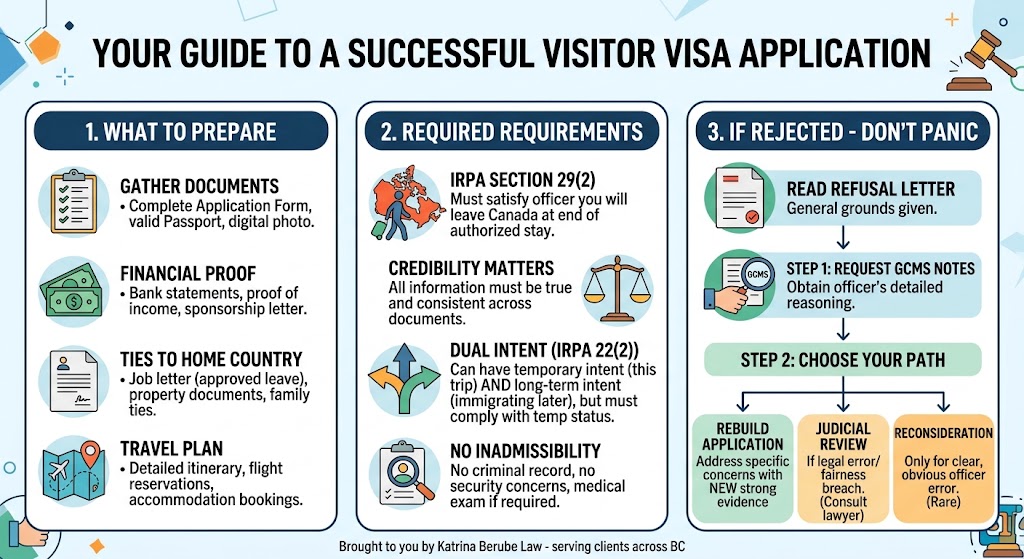
Under IRPR section 179, an officer will only issue a visitor visa where satisfied you’ll genuinely leave Canada by the end of your authorized stay and aren’t inadmissible. In practice, this means building a file around:
- A valid passport with sufficient remaining validity
- Proof of sufficient financial support for the entire visit — bank statements, income evidence, or a formal invitation with financial support documented Clear
- Specific ties to your home country — employment (a letter confirming your position and approved leave), property ownership, family responsibilities, ongoing studies
- A clear, specific, and honest purpose of visit — not just “tourism,” but an actual, documented plan No criminal or medical inadmissibility, with a medical exam where required A clean and consistent travel history, where you have one
This is the broadest and most document-light temporary status available — but “document-light” is exactly why weak applications fail. There’s no points grid to hide behind here; every document has to do real persuasive work on its own. This is where we spend the most deliberate effort: not just gathering documents, but presenting them so the officer’s core question is answered clearly, not left for them to infer. The processing times vary by country and application volume, with a link to IRCC’s check-processing-times tool.
3. What Is the Principle Underneath All Required Documents? (Understanding This Helps You Prepare)
Every document on that list above exists to answer one single legal question, set out in IRPA section 29(2): will you leave Canada at the end of your authorized stay? Everything else — your finances, your ties, your travel history, your stated purpose — is evidence submitted toward that one determination, not separate boxes to check independently.
This matters practically because of a related principle: dual intent, recognized under IRPA section 22(2). You’re legally allowed to hold both a temporary purpose for this specific trip and a longer-term hope of immigrating to Canada someday — the two aren’t automatically contradictory. What actually matters is whether you have a credible, specific plan for complying with your temporary status: leaving on time, or lawfully continuing your status from within Canada if a longer-term application is separately in progress. A vague hope of “maybe staying” isn’t disqualifying on its own, but a plan with no clear compliance mechanism attached is.
Once you understand this single organizing question, document selection stops being guesswork — every piece of evidence you gather should be chosen because it makes the “will leave” answer clearer, not because a checklist somewhere said to include it. This is the actual strategy behind how we build a file, and it’s the difference between a stack of documents and a genuinely persuasive application.
4. Most Common Cause of Rejection
The most frequent refusal reasons, consistently, are:
- Insufficient or unclear evidence of ties to the home country
- Insufficient financial resources, or funds that exist but aren’t clearly documented
- An unclear or generic stated purpose of visit Limited travel history — though officers aren’t supposed to weigh a thin travel history against an applicant on its own; it’s meant to be one data point, not a disqualifying factor by itself Prior immigration violations, including overstays or previous refusals not properly addressed in a later application
A refusal letter typically cites the general ground but rarely explains the specific reasoning in real depth — which is precisely why so many applicants reapply without ever actually knowing what went wrong the first time.
5. Credibility Always Matters
Every fact in your application is assessed against every other fact — consistency across your documents, your stated purpose, and your answers is what builds credibility, and any contradiction, however small, invites exactly the scrutiny you’re trying to avoid. An officer isn’t just checking boxes; they’re forming a genuine impression of whether your account holds together. This is why we review your full file for internal consistency before submission — not just whether each document individually looks right, but whether the whole story they tell together is coherent and genuine.
6. What Can I Do If My Visitor Visa Has Been Rejected Twice?
Two refusals in a row means whatever you changed the first time didn’t address the actual underlying concern — and reapplying a third time with only minor tweaks is unlikely to produce a different result. At this point, the right first move is requesting the officer’s GCMS notes through a Privacy Act request, since the refusal letter itself rarely explains the real reasoning in sufficient detail to fix it properly.
From there, three real options exist:
A genuinely rebuilt reapplication — not a resubmission of the same file with small additions, but one built specifically around whatever the GCMS notes reveal was actually the concern.
Judicial review at the Federal Court — available where the refusal itself was unreasonable or procedurally unfair, filed within 15 days if you’re in Canada or 60 days if outside Canada. This isn’t a chance to resubmit a stronger case; it’s a review of whether the original decision was legally sound.
A reconsideration request — used narrowly, where the officer appears to have made a clear, identifiable error, rather than a genuine disagreement about how evidence was weighed.
After two refusals, we don’t recommend simply trying again with the same strategy — we obtain the actual reasoning first, then decide which of these three paths genuinely fits what went wrong.
7. Who Should Consider Appeal?
Here’s the honest, and often frustrating, answer: there is no traditional appeal board for visitor visa refusals — no Immigration Appeal Division route exists for a TRV or eTA decision, unlike some other refusal categories. What’s sometimes loosely called “appealing” a visitor visa refusal is, legally, one of the three routes above: a stronger reapplication, a reconsideration request, or judicial review.
Judicial review specifically is worth considering where there’s a genuine, identifiable legal error or fairness breach in how the decision was made — not simply because the outcome was disappointing. A case built around “I disagree with how the officer weighed my evidence” rarely succeeds under judicial review’s reasonableness standard. A case built around a documented, specific error — evidence the officer clearly overlooked, a fairness breach, or a legally unsupportable conclusion — is a genuinely different, and stronger, position. We review refused files honestly against this distinction before recommending judicial review, so you’re not spending months and real cost pursuing a route that was never going to succeed.
8. Where Katrina Berube Law Makes the Difference
A visitor visa looks simple precisely because IRCC doesn’t hand you a checklist that guarantees approval — there’s no formula here, only a single question every document has to answer clearly. That’s exactly where most self-prepared applications quietly fail: not from missing documents, but from documents that were never organized around actually proving the one thing that matters. Serving Vancouver and clients across all of BC, Katrina Berube Law builds your visitor visa application — or your reapplication after a refusal — around that single organizing principle, so an officer isn’t left inferring your intent to leave. They’re shown it, clearly, the first time.