An LMIA sits at the center of most employer-driven work permits in Canada, and misunderstanding it costs both employers and foreign workers real money — employers through refused, non-refundable applications, and workers through a fraud pattern that specifically targets people relying on an LMIA-supported job offer. This guide covers both sides honestly.
1. What Is an LMIA?
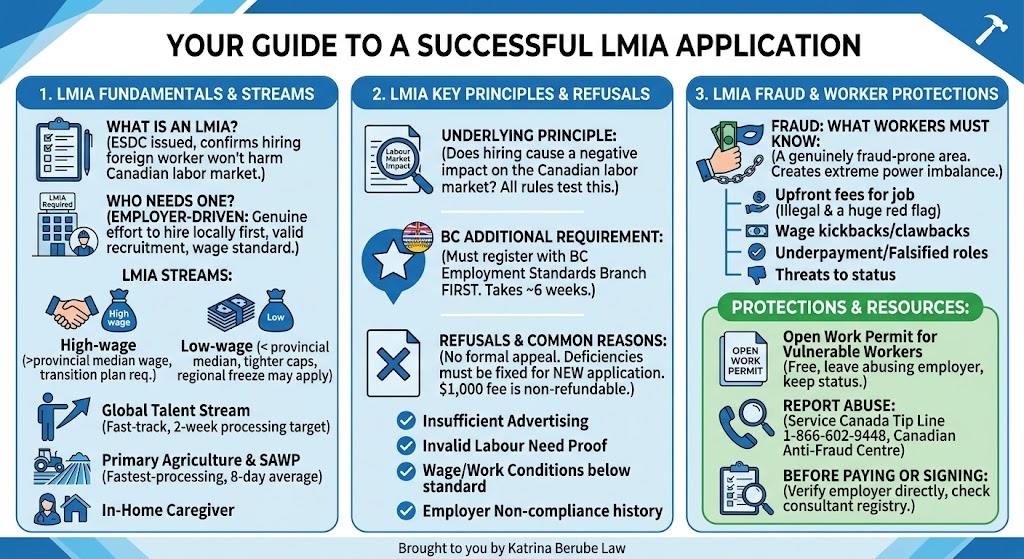
A Labour Market Impact Assessment is a document issued by Employment and Social Development Canada (ESDC), confirming that hiring a specific foreign worker for a specific position won’t have a negative effect on the Canadian labour market. A positive LMIA is what allows a Canadian employer to support an employer-specific work permit application under the Temporary Foreign Worker Program (TFWP) — a structurally different process from the LMIA-exempt International Mobility Program.
2. Who Needs One?
The employer needs the LMIA, not the foreign worker — this is a common point of confusion. Before most employer-specific work permit applications can proceed, the Canadian employer must obtain a positive LMIA, which requires demonstrating a genuine effort to hire a Canadian citizen or permanent resident first: advertising the position for a set period (recently extended to eight consecutive weeks as of April 2026), showing concrete recruitment efforts, and offering wages and conditions that meet or exceed the applicable provincial standard.
If your job offer doesn’t require an LMIA, it should fall under a specific, identifiable exemption within the International Mobility Program — not simply “the employer didn’t bother,” which is itself a red flag worth investigating, discussed further below.
3. The LMIA Streams
The Temporary Foreign Worker Program runs six distinct streams, and which one applies changes the requirements, processing time, and worker protections significantly:
High-wage stream: For positions paying at or above the provincial median hourly wage (roughly CAD $27–29/hour in most provinces as of 2026, higher in BC). No cap on the proportion of temporary foreign workers, and no employer-paid transportation or housing requirement, but a transition plan toward reduced reliance on foreign labour is required.
Low-wage stream: For positions below the provincial median. Subject to tighter caps, additional worker protections, and — since 2024 — a processing freeze in regions where local unemployment is 6% or higher, an area list ESDC updates quarterly.
Global Talent Stream (GTS): A fast-track stream for high-growth companies and specialized tech occupations, targeting a two-week processing standard — though in practice, current wait times have run closer to 10 days on average.
Primary Agriculture Stream and Seasonal Agricultural Worker Program (SAWP): For agricultural employment, generally the fastest-processing streams, with SAWP averaging roughly 8 business days.
In-Home Caregiver Stream: For caregivers working in a private household.
Processing times vary substantially and change frequently — recent published figures have ranged from roughly 8–10 business days for GTS and SAWP up to 70–90 business days for high-wage and low-wage applications. Always confirm current timelines directly against ESDC’s published processing times rather than relying on a fixed number.
4. What Is Required for an LMIA Application
Every LMIA application, regardless of stream, is assessed against four core requirements, and the specific documents you need flow directly from them:
Business legitimacy — your business must be legally established and actively operating in Canada. Expect to provide registration or incorporation documents, a business licence, and financial records such as T2 Schedule 100/125, a T4 Summary of Remuneration Paid, and your most recent PD7A remittance slip. Newer businesses without a filing history face closer scrutiny here.
Financial capacity — evidence you can actually pay the offered wage for the full employment period, which can be a genuine obstacle for new businesses, businesses showing losses, or sole proprietorships with no existing employees.
A genuine, detailed job offer — matching the correct NOC code, with duties, wages, and working conditions that meet the applicable prevailing wage and standard employment conditions for that occupation and region.
Recruitment and advertising evidence — proof the position was advertised on Job Bank plus at least two additional recruitment platforms, generally for a minimum of four consecutive weeks within the three months before submission (some categories now require a longer period following an April 2026 update, so confirm the current requirement for your specific stream before relying on a fixed number). At least one recruitment activity must remain active until a decision is issued, and you’ll need a documented summary of the recruitment results — how many Canadians or permanent residents applied, and specifically why each one wasn’t hired.
Stream-specific additions: high-wage applications require a formal Transition Plan describing how you’ll reduce reliance on temporary foreign workers over time; Global Talent Stream applications require a Labour Market Benefits Plan instead; and low-wage applications require a cap calculation plus proof of covering round-trip transportation and providing access to suitable, affordable housing.
Finally, the $1,000 per-position processing fee is paid on submission — non-refundable, with refunds issued only where the fee was genuinely collected in error, not simply because the LMIA was later refused or withdrawn.
Because officers form an early impression of an application’s credibility within the first few minutes of reviewing it, incomplete or inconsistent documentation — a mismatched job title, an outdated business address on a tax form, recruitment evidence that doesn’t actually match the advertised role — is one of the most common, and most avoidable, reasons a genuinely legitimate application still gets refused.
4-1. BC’s Additional Requirement: Temporary Foreign Worker Protection Act Registration
Here’s a step many employers miss entirely, because it’s provincial, not federal: under BC’s Temporary Foreign Worker Protection Act, an employer must register with the BC Employment Standards Branch and hold a valid certificate of registration before obtaining an LMIA. This registration isn’t submitted to ESDC — BC’s own public registry is the official record, and a certificate typically takes around six weeks to process, so this isn’t something to leave until the LMIA application is otherwise ready. Employers hiring exclusively through the Provincial Nominee Program or the International Mobility Program don’t need this registration, but any BC employer pursuing an LMIA-based hire does.
5. Common Reasons for LMIA Refusal
Refusals typically stem from: insufficient or improperly documented advertising efforts, an inability to demonstrate a genuine labour shortage, wages or working conditions below the required provincial standard, employer compliance issues from previous foreign worker hiring, or a low-wage application filed in a region currently subject to the unemployment-rate processing freeze — which results in the file being returned without assessment at all, distinct from an actual refusal on the merits. LMIA processing times vary for each LMIA stream.
6. What Happens If an LMIA Is Refused?
There is no formal appeal for an LMIA refusal. The employer’s only real option is to address the specific deficiency ESDC identified and submit a fresh application — and the $1,000 application fee is non-refundable regardless of the outcome, which makes getting the application right the first time considerably more valuable than treating it as a low-cost first attempt.
7. LMIA Fraud: What Every Foreign Worker Needs to Know
I want to be direct about this, because it deserves more than a warning paragraph: the LMIA system is a genuinely fraud- and corruption-prone area of Canadian immigration, and the reason is structural, not incidental. An employer-specific work permit ties a worker to one named employer — which means the moment a worker has already paid money, uprooted their life, and arrived in Canada, the employer holds enormous leverage over someone who often has no realistic way to walk away. That power imbalance is exactly what predatory employers and recruiters are built to exploit.
How the exploitation actually works. This isn’t limited to a single scam pattern — it takes several recurring forms:
- Upfront fees for the “job” itself. Fraudulent recruiters and employers charge workers anywhere from a few thousand to, in documented extreme cases, $50,000–$75,000 for an LMIA-backed job offer — sometimes for a position that doesn’t genuinely exist at all.
- Wage kickback and clawback schemes. Some employers pay the wage stated on official pay stubs (satisfying the LMIA’s on-paper requirements), then require the worker to pay a portion of it back in cash — effectively making the worker fund their own “recruitment fee” through their own earnings, sometimes framed as debt repayment for the original fee.
- Underpayment disguised by paperwork. Workers are paid below the LMIA-approved wage or placed in a lower-skill role than advertised, while documentation is falsified to show compliance on paper.
- Coercion through immigration status itself. Because the work permit is tied to the employer, workers who complain about wages, unsafe conditions, or unpaid overtime are frequently threatened — explicitly or implicitly — with termination and the loss of their status, discouraging them from ever reporting the abuse.
- Confiscated documents and excessive control. In the most severe, well-documented cases, immigration lawyers describe this as bordering on “a form of pseudo slavery” — passports withheld, movement restricted, and further money demanded even at the permanent residence stage.
The scale of this is not small. ESDC’s own 2025–2026 compliance results found 12% of inspected employers non-compliant, with penalties totalling over $10.2 million — more than double the prior year’s figure — and 30 employers banned from the program entirely. Separately, applications for the Open Work Permit for Vulnerable Workers rose from roughly 875 in 2021 to more than 9,600 in 2025, a scale of increase that reflects both growing awareness and a genuinely widespread underlying problem.
What’s illegal, stated plainly:
- Charging a worker any fee for an LMIA, connected to it, or labelled as a “recruitment,” “processing,” or “LMIA cost” is illegal under IRPA, regardless of how it’s described or disguised.
- Most provinces — including BC, Manitoba, Ontario, Nova Scotia, Saskatchewan, New Brunswick, and Alberta — require foreign-worker recruiters to be licensed and specifically prohibit charging the worker any recruitment fee at all.
- The $1,000 LMIA fee and the $230 employer compliance fee are, without exception, the employer’s responsibility.
What to do if you’re experiencing this. The Open Work Permit for Vulnerable Workers allows a worker experiencing or at genuine risk of abuse to leave the employer named on their LMIA — the application is free, and a worker who reports abuse keeps their status while it’s investigated. Report non-compliant employers to Service Canada’s Tip Line (1-866-602-9448, responded to within 48 hours) or to the Canadian Anti-Fraud Centre, and check ESDC’s published list of employers banned for non-compliance before accepting any offer. One important nuance from a February 2026 IRCC clarification: a worker who knowingly paid for a fraudulent job offer that never had genuine employment behind it may not qualify as “abuse” for this specific permit — which is exactly why verifying an offer’s legitimacy before paying anything matters as much as knowing your rights after the fact.
Before you pay anyone, or sign anything: verify the employer directly, check any immigration consultant against the College of Immigration and Citizenship Consultants (CICC) public registry, and treat any request for payment connected to a job offer or LMIA as an immediate, absolute red flag — not a negotiable cost of entry.
8. Understanding the Underlying Principle
Every requirement in the LMIA process exists to answer one question: would hiring this specific foreign worker for this specific position cause a negative impact on the Canadian labour market? The advertising requirement, the wage threshold, the transition plan, the stream-specific caps — all of it is evidence toward that single determination. Once you see the process this way, it becomes clear why a genuine, well-documented labour need succeeds and a thin or poorly evidenced one doesn’t, regardless of how badly the employer wants to make the hire.
9. Where Katrina Berube Law Makes the Difference
Whether you’re an employer navigating which stream actually applies to your hire, including BC’s separate registration requirement most guides don’t mention, or a foreign worker trying to tell a genuine opportunity apart from a fraud pattern built specifically to exploit hope, getting this right the first time matters — an LMIA refusal costs real, non-refundable money, and LMIA fraud costs workers far more. Serving Vancouver and clients across all of BC, Katrina Berube Law helps you verify what you’re actually looking at before you commit time, money, or trust to it.