I want to be direct about this pathway before explaining anything else about it: H&C is not a backup plan, and it is not something to “try” because another pathway didn’t work out. It exists for people already living through genuinely exceptional circumstances — and treating it as a low-cost long shot doesn’t just waste time and money, it can work against you later. This post explains why, and who this pathway actually exists to help.
1. What Is H&C?
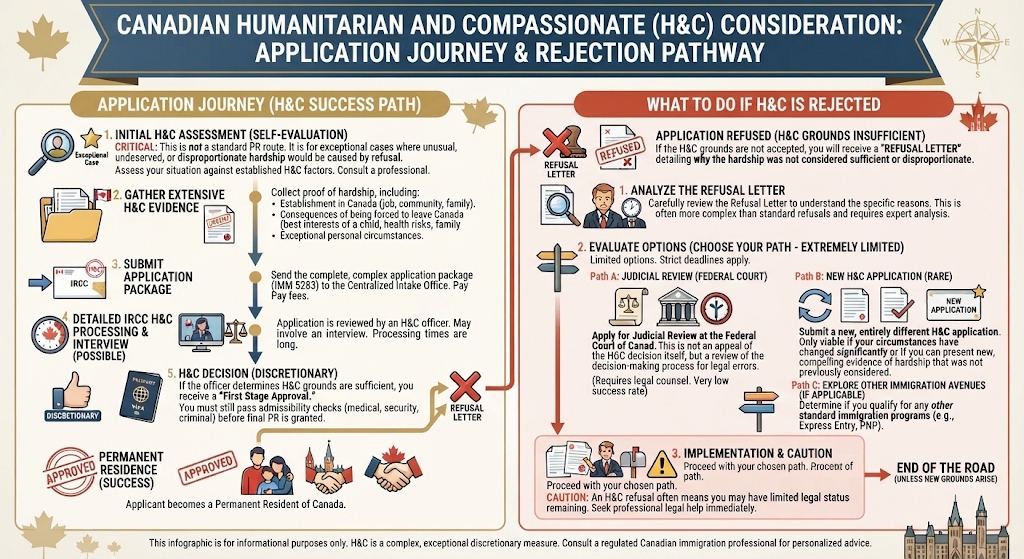
Humanitarian and Compassionate consideration, under section 25(1) of the Immigration and Refugee Protection Act, allows the Minister to grant permanent residence, or an exemption from a specific legal requirement, to someone whose circumstances don’t fit any regular immigration category, but whose situation is compelling enough to justify relief on humanitarian grounds. It is discretionary — nobody is entitled to H&C relief simply by asking for it — and exceptional, meaning it’s built for situations the standard immigration system genuinely wasn’t designed to address, not for situations where someone simply didn’t qualify for an easier route.
2. Who Is Eligible for H&C?
Almost anyone can technically submit an H&C application — the regulatory bar to filing is low. This is precisely why the outcome bar is so high, and why eligibility to apply should never be confused with a realistic chance of approval.
To be eligible to file, you generally need to be in Canada and either inadmissible or not meeting the requirements of the Act for the status you’re seeking (a request can also be made from outside Canada in narrower circumstances). Beyond that procedural threshold, the real question isn’t “am I eligible to apply” — it’s whether your actual circumstances meet the substantive test described below, which is a fundamentally different and much narrower question.
3. When Is H&C Granted?
The governing legal test comes from the Supreme Court of Canada’s decision in Kanthasamy v. Canada, 2015 SCC 61: an officer must assess, on the whole of the evidence, whether the applicant’s circumstances would excite in a reasonable person a desire to relieve their misfortunes. This is a holistic, equitable inquiry — not a checklist, and not a formula where clearing enough individual boxes guarantees an outcome.
Officers weigh factors including:
- Establishment in Canada — employment history, community and family ties, language integration, and the depth of your actual life here
- Hardship on return — genuine difficulty you would face if required to leave Canada and apply from abroad, assessed as part of the whole picture rather than against a rigid hardship threshold
- Best interests of any child directly affected — given substantial weight, and specifically not to be treated as a mere afterthought, but not automatically outweighing every other factor either
- Health considerations and country conditions, where genuinely relevant to your circumstances
Cases tend to succeed on a genuine combination of these factors pointing the same direction — not on any single factor standing alone, however sympathetic.
4. What’s the Most Difficult Aspect of an H&C Application?
The most difficult part isn’t the paperwork — it’s that there is no formula here to satisfy. Unlike an economic-class application, where meeting defined criteria produces a defined result, H&C asks an officer to form a genuine, subjective opinion about whether your specific circumstances warrant an exception to the rules everyone else has to follow. Two files with similar facts can reach different outcomes, because the test is inherently about judgment, not calculation.
A second, often underestimated difficulty: an H&C application does not create a statutory stay of removal. If you’re under a removal order while your H&C is pending, filing the application doesn’t pause that process on its own — a separate deferral request or stay motion may be necessary, and there’s no guarantee either succeeds before removal proceeds. Approval, when it happens, is also only the first stage — a subsequent permanent residence application still follows, with its own processing time.
5. Who Is H&C Actually Designed For?
This is the question that matters most, and the honest answer is narrower than most people assume. H&C exists for people who genuinely:
- Have no other immigration pathway that reasonably applies to their actual circumstances — not a pathway they simply didn’t pursue or prepare for, but one that genuinely doesn’t fit
- Have built real, substantial establishment in Canada — years of community, family, and often economic contribution that would be genuinely disrupted, not a recent or thin connection
- Face circumstances that would produce real, documented hardship if they had to leave — not inconvenience, disruption of preference, or a harder path to the outcome they wanted
- Have a child whose circumstances are genuinely, specifically affected — not a general assertion that leaving Canada would be difficult for a family
If you recognize your own situation clearly in that list, H&C may genuinely be worth pursuing. If you’re reading it hoping to find language broad enough to fit a situation that’s really just “I’d prefer to stay and nothing else worked,” that gap is exactly what officers are trained to identify.
6. “I Don’t Fit Any Other Pathway — Can I Try H&C Since I Have Nothing to Lose?”
No — and I want to be plain about why, because this assumption causes real harm.
It costs real money and real time. Government fees apply, and cases can take well over a year to be decided — often considerably longer. That’s time and money not spent building a genuine case for a pathway that might actually apply to you.
It doesn’t pause your immigration status or protect you from removal. If you’re already out of status or under a removal order, filing an H&C application doesn’t create automatic protection while it’s pending — removal proceedings can continue regardless, and stopping them requires a separate, uncertain legal step.
A weak or clearly unfounded application isn’t neutral — it can actively work against you. Officers see the full pattern of a person’s immigration history. An H&C filing built on thin, generic, or stretched claims doesn’t just fail quietly; it becomes part of your record, and it can undermine your credibility in any future application, including a genuinely stronger one you might have a real basis for later.
It isn’t designed to be a second chance at a refused claim. Under section 25(1.3), factors that were already considered and rejected in a refugee determination generally can’t simply be re-argued here — H&C isn’t a way to relitigate a claim through a different door.
The honest test isn’t “do I have anything to lose.” It’s “does my actual situation genuinely match what this pathway exists for” — established life in Canada, real and specific hardship, and no other route that reasonably applies. If it does, this is a serious and legitimate path forward, and worth pursuing properly. If it doesn’t, the better use of your time is almost always finding out which pathway actually does fit your circumstances — not spending a year waiting on an application built on hope rather than facts.
7. If You’re Genuinely Unsure Where You Stand
The gap between “I want to stay” and “my circumstances genuinely meet the Kanthasamy test” is exactly the assessment worth having done honestly, before you file anything. Serving Vancouver and clients across all of BC, Katrina Berube Law reviews your actual circumstances against this test directly — including telling you plainly when H&C isn’t the right route, and what is.